Tel/WhatsApp
0086 135 2661 5783

Henan Jinrui Food Engineering Co., Ltd

If you are running a cassava flour operation in Thailand and struggling with inconsistent product quality, uneven texture, or buyers turning you down because your flour does not meet their standards—wet processing is the solution most successful processors have already moved to. Now, Henan Jinrui explains exactly how wet cassava flour milling works, what equipment is involved, and how to choose the right throughput for your operation.
The wet milling process for cassava flour consists of six stages, each building on the last. Get each stage right, and the next one becomes much easier. Miss one, and the problem carries through to the final product.
Stage 1: Washing
Freshly harvested cassava roots carry soil, sand, stones, and other field impurities. The washing process involves two steps: first, the cassava passes through a dry sieve to remove surface debris; then, it enters a paddle washer, where the root surfaces are thoroughly cleaned using a counter-current washing method. The importance of washing goes beyond mere surface cleanliness; residual sand particles can contaminate the final flour, compromising its purity and—crucially for buyer quality assessments—its color. Furthermore, sand particles accelerate wear and tear on downstream equipment.
Stage 2: Peeling
The washed cassava roots enter a peeling machine to remove the outer skin. The skin harbors the majority of surface impurities; if peeling is incomplete, dark spots and off-flavors will carry over into the final flour and cannot be removed later. Achieving a high peeling rate of 96% at this stage lays the foundation for producing clean, bright-colored cassava flour that meets buyer quality standards.
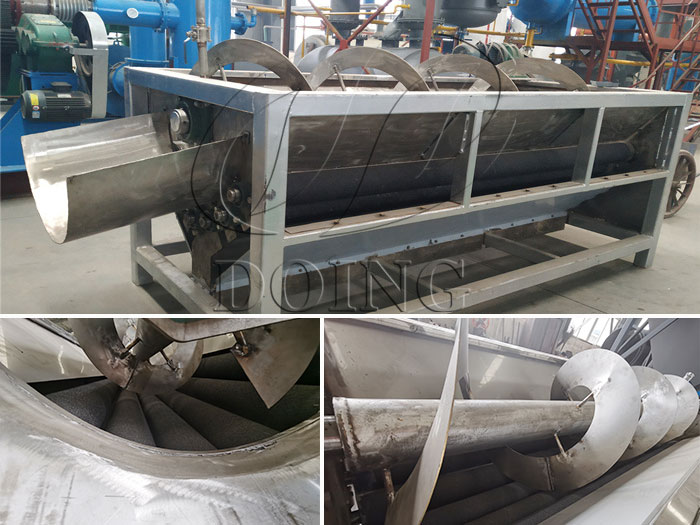 Henan Jinrui automatic cassava peeler
Stage 3: Crushing
After peeling, the cassava roots first enter a cutting machine, where they are sliced into uniform pieces to ensure consistent feeding into the next stage. These pieces then enter a rasper to be processed into a fine, uniform cassava slurry. This slurry is subsequently dewatered and dried to create the final product. The finer and more uniform the slurry, the smoother and higher-quality the resulting flour will be. Uneven or overly coarse grinding results in inconsistent flour texture and reduced quality.
Stage 4: Dewatering
The finely ground cassava slurry enters a plate-and-frame filter press, where most of the water is removed to form a filter cake with a moisture content of approximately 40%. Proper dewatering at this stage significantly accelerates the subsequent drying process and improves energy efficiency. If the slurry enters the dryer with excessive moisture, drying times increase and energy consumption rises. Conversely, over-pressing can damage the structure of the cassava flour.
Stage 5: Drying
The filter cake enters a flash dryer, which rapidly reduces the moisture content to around 12%—the standard level for safe flour storage. The dryer evaporates moisture using controlled airflow and temperature, ensuring the material does not overheat. Excessive temperatures can damage the cassava flour granules, negatively affecting the flour's functional properties and color. With proper processing, the finished flour boasts a longer shelf life and a clean, bright appearance.
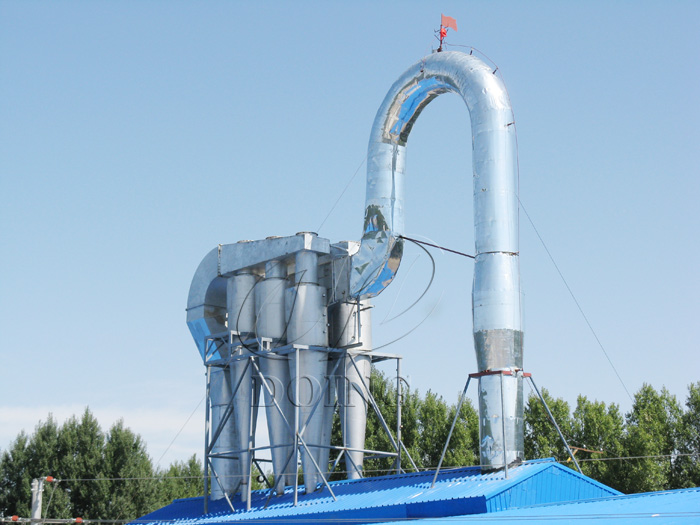 The drying equipment for cassava flour process
Stage 6: Sieving and Packaging
Before packaging, the dried flour passes through a vibrating sifter to ensure uniform particle fineness and remove coarse particles. It then enters an automated packaging machine for clean, consistent bagging. Uniform fineness and professional packaging are key to ensuring your product looks premium and trustworthy—whether on store shelves or in a buyer's warehouse.
Knowing how the process works naturally leads to the next question: how big does your line need to be? The answer depends on three things—your raw material supply, your target market, and your budget. Here is a practical reference:
| Your Situation | Throughput | Key Benefit |
| Starting out or testing the local market | 1–2 tons/hour | Easy to start, simple to expand |
| Supplying regional distributors or local food companies | 2–5 tons/hour | Balanced output and cost |
| Targeting export buyers or large food manufacturers | 5+ tons/hour | Maximum efficiency, consistent quality |
All configurations operate under PLC-based automated control, so once the line is calibrated, the system maintains stable output batch after batch.
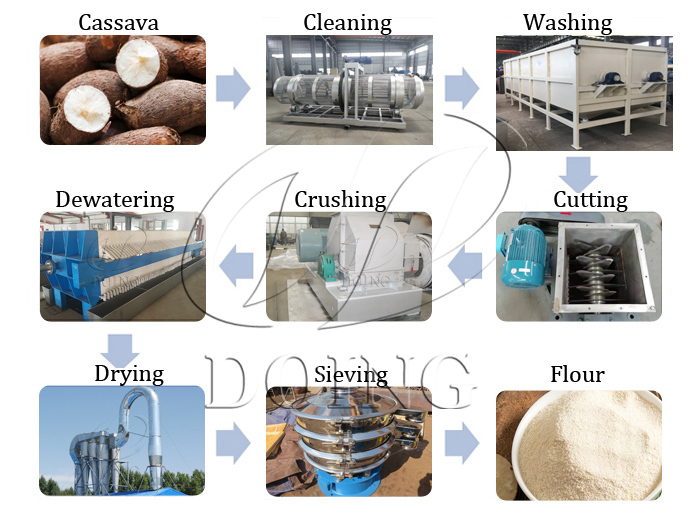 The wet milling process and equipment
Choosing the right throughput is an important decision—but the manufacturer you work with matters just as much. Henan Jinrui has successfully delivered wet-process cassava flour production lines to processors across multiple regions in Thailand. We provide full project support from design and manufacturing to installation and after-sales service. We welcome you as our partner.
Q1: What is the cassava flour yield rate?
A: Approximately 4 tons of fresh cassava roots produce 1 ton of cassava flour — a yield rate of around 25%. Actual yield varies based on: the starch content of your cassava variety (Thai varieties generally have high starch content, which supports good yield), how fresh the roots are at processing time (yield drops the longer roots sit after harvest), and the efficiency of your rasping and extraction equipment. Using precision rasping equipment improves starch release and raises your effective yield.
Q2: How much does a cassava flour production line cost? A: Cost depends on throughput and automation level. A 1–2 ton/hour semi-automatic line requires a moderate investment — suitable for processors entering the market or expanding from manual methods. A fully automatic 5+ ton/hour line represents a higher upfront commitment but delivers significantly lower operating cost per ton. Henan Jinrui provides factory-direct pricing with no middleman markup. Contact us with your capacity target and we will send a detailed CIF quotation — including shipping to your port in Thailand.
Q3: What is the power consumption of the production line? A: Power requirements vary by configuration. A 1–2 ton/hour line typically requires 80–150 kW. A medium-to-large line (5+ tons/hour) may need 300–500 kW or more. We include specific power requirements in every customized proposal so you can plan your utility capacity accurately.
Q4: What equipment material do you use for food-contact parts? A: All parts that contact food — including washing drums, peeling cones, rasping cylinders, dewatering presses, and drying chambers — are made of 304 stainless steel. This meets international food safety standards, resists corrosion, and ensures clean, hygienic production. We do not use carbon steel or lower-grade stainless for food-contact surfaces in any configuration.
Q5: What does the warranty cover and how does after-sales support work? A: Our standard warranty is 12 months from shipment, covering manufacturing defects in materials and workmanship. Wearing parts (screens, blades, bearings, seals) are covered for 6 months. We provide remote technical support for all customers. For larger projects, on-site installation engineers are available on request. We also maintain spare parts inventory and can ship critical parts quickly to Thailand and across Southeast Asia.
 Tapioca Starch Plant Upgrade: How Can I Increase Production Capacity?
Cassava Flour Milling in Thailand: Process, Equipment, and Throughput
How Many Tons of Potatoes Make 1 Ton of Starch? How to Start a Profitable Potato Starch Processing Business?
How Much Space for a 5tph Cassava Starch Processing Plant? Complete Factory Layout & Setup Guide
What Is the Market Price of Cassava Flour and Is Cassava Flour Processing Profitable?
From Fresh Cassava to Cassava Flour: A Complete Dry Process
Can cassava flour processing be a profitable alternative to wheat flour?
Is the Fufu Flour Processing Business Profitable?
Why Is the HQCF (High Quality Cassava Flour) Processing Business So Popular in Nigeria?
What Budget Is Required to Start a Cassava Flour Production Business in Congo?
Henan Jinrui Secures 2-in-1 Processing Line Project for Garri and Cassava Flour Production in Gabon
Henan Jinrui delivers attieke processing equipment to the customer in Côte d'Ivoire
Henan Jinrui Successfully Ships Cassava Flour Processing Line to Madagascar Client
Henan Jinrui Advanced Cassava Starch Processing Equipment Wins Over Nigerian Food Processor
Henan Jinrui Delivers Custom 1TPD Garri & Attieke Making Equipment to Benin
Tapioca Starch Plant Upgrade: How Can I Increase Production Capacity?
Cassava Flour Milling in Thailand: Process, Equipment, and Throughput
How Many Tons of Potatoes Make 1 Ton of Starch? How to Start a Profitable Potato Starch Processing Business?
How Much Space for a 5tph Cassava Starch Processing Plant? Complete Factory Layout & Setup Guide
What Is the Market Price of Cassava Flour and Is Cassava Flour Processing Profitable?
From Fresh Cassava to Cassava Flour: A Complete Dry Process
Can cassava flour processing be a profitable alternative to wheat flour?
Is the Fufu Flour Processing Business Profitable?
Why Is the HQCF (High Quality Cassava Flour) Processing Business So Popular in Nigeria?
What Budget Is Required to Start a Cassava Flour Production Business in Congo?
Henan Jinrui Secures 2-in-1 Processing Line Project for Garri and Cassava Flour Production in Gabon
Henan Jinrui delivers attieke processing equipment to the customer in Côte d'Ivoire
Henan Jinrui Successfully Ships Cassava Flour Processing Line to Madagascar Client
Henan Jinrui Advanced Cassava Starch Processing Equipment Wins Over Nigerian Food Processor
Henan Jinrui Delivers Custom 1TPD Garri & Attieke Making Equipment to Benin
Jinrui Foodtech offers cassava processing machine from single machine to the complete production line. If you want to get more details about Cassava Flour Milling in Thailand: Process, Equipment, and Throughput , please contact us: