Tel/WhatsApp
0086 135 2661 5783

Henan Jinrui Food Engineering Co., Ltd

 Home>News>Enterprise news > Jinrui Foodtech Signs Rasper Order With Philippine Cassava Starch Producer for a Phased Line Upgrade
On September 25, 2026, Jinrui Foodtech (Henan Jinrui) agreed a purchase contract with a cassava starch producer in the Philippines for a single CM-8435 Rasper. Rather than rebuild a whole line at once, the customer chose to start with one machine and let it prove itself before any wider rollout. That phased logic — verify first, scale later — shaped every decision from model choice down to commissioning.
The customer operates two cassava starch plants in the country. One runs an ageing rasping stage that had begun to limit recovery, so the upgrade began there, as a controlled, low-risk step. We worked the configuration through with the customer and confirmed a single CM-8435 as the starting point.
For a two-plant operator the risk is not buying a machine but interrupting output that already sells. The customer therefore framed the upgrade around recovery on the line they already trust. In our exchanges we pinned the requirement to three checks:
Starch recovery first: improving how much starch each tonne of cassava returns, instead of chasing headline throughput alone.
Fit to the existing station: confirming footprint and process interfaces so the new unit takes over cleanly from the old rasper.
A reversible step: starting with one unit so performance can be measured before the second plant is committed.
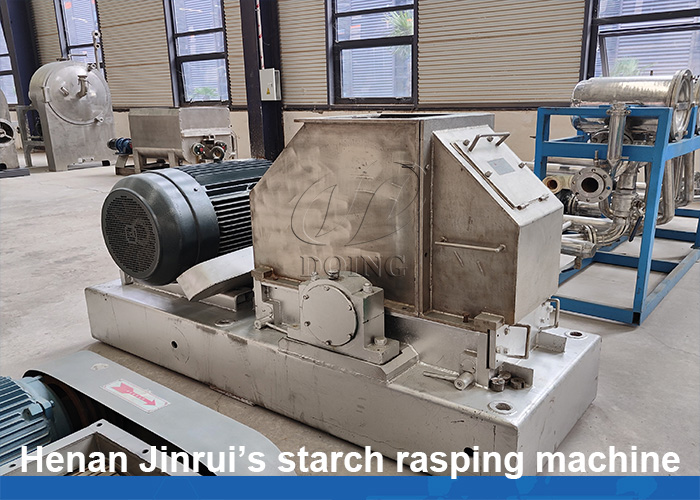 Jinrui Foodtech's rasper
The path to contract was deliberate and unhurried:
August 6, 2026: referred by an existing customer, the buyer opened an inquiry through Alibaba International, asking about the rasper itself before anything else.
September 3, 2026: the plant maintenance lead returned to move the purchase forward, and we began preparing the proforma invoice (PI).
September 25, 2026: both sides signed for one CM-8435 Rasper.
Across those weeks we answered point by point on capacity, mounting interface and recovery expectations, so the customer committed only once the fit was clear.
On a cassava starch line the rasper sits at the front and does the most basic but decisive job: it breaks washed roots into a fine pulp so the starch cells open. The cleaner that break, the more starch the downstream stages can recover — which makes rasping efficiency the real ceiling on overall yield. Every figure below corresponds to the CM-8435 model (Jinrui Foodtech specifications).
| Item | CM-8435 |
|---|---|
| Model | CM-8435 |
| Capacity | 20 t/h |
| Rotor diameter | Φ840 mm |
| Rotor speed | 2100 r/min |
| Motor power | 110 kW |
| Overall dimensions | 2180 × 1310 × 1190 mm |
| Machine weight | 2800 kg |
A thorough break, a higher yield: a rasping rate above 94% opens the starch cells well, supporting roughly 4 tonnes of cassava to 1 tonne of starch and lifting recovery on the same raw material.
Food-grade contact surfaces: parts touching the material are food-grade stainless — corrosion-resistant and easy to clean, holding hygiene steady through long runs.
Stable high-speed running: SKF bearings with a Φ840 mm high-speed rotor keep the break consistent and wear low, so recovery does not drift with downtime.
For the customer this was a contained, measured replacement: prove one CM-8435 against a working line, then decide from results. For us it confirmed a habit worth keeping — upgrade plans start from what the plant already recovers and can prove, not from the single biggest number on a datasheet.
If your cassava, sweet potato or other root-starch plant is weighing ageing equipment, a capacity gap or a phased rollout, talk to the Jinrui Foodtech engineering team. Working from your existing line and target recovery, we will shape a staged equipment-upgrade plan — prove one unit first, scale once it performs — so each step rests on measured results rather than a single spec.
 Jinrui Foodtech Signs Rasper Order With Philippine Cassava Starch Producer for a Phased Line Upgrade
Jinrui Foodtech Secures 2-in-1 Processing Line Project for Garri and Cassava Flour Production in Gabon
Jinrui Foodtech delivers attieke processing equipment to the customer in Côte d'Ivoire
Jinrui Foodtech Successfully Ships Cassava Flour Processing Line to Madagascar Client
Jinrui Foodtech Advanced Cassava Starch Processing Equipment Wins Over Nigerian Food Processor
Jinrui Foodtech offers cassava processing machine from single machine to the complete production line. If you want to get more details about Jinrui Foodtech Signs Rasper Order With Philippine Cassava Starch Producer for a Phased Line Upgrade , please contact us: