Tel/WhatsApp
0086 135 2661 5783

Henan Jinrui Food Engineering Co., Ltd

You can lift a tapioca starch plant’s output by 50% or more without rebuilding it or adding a second line. The work almost always lands on three stages: rasping, separation, and drying. Find which one caps your plant, upgrade the equipment and process there, and the rest follows.
The path is the same for almost every plant: locate the bottleneck, scope the upgrade on your existing line, change what each stage needs, then install with minimal downtime and ramp up.
Capacity rarely fails everywhere at once — it fails at one point. Find it before you buy anything.
Four stages usually cap a tapioca starch plant:
Rasping / extraction — sets both yield and throughput; a coarse cut leaves starch in the fiber
Separation / washing — sets purity and separation capacity; grade drops as you push speed up
Drying — the final, often hardest limit; moisture won’t drop and the whole line waits
Water and energy loop — feeds all of the above; utilities hit their limit first
Don’t guess. Run a one-week production log and record two numbers at every stage: output per hour and downtime. The stage with the lowest sustained throughput, or the most stoppages, is your bottleneck. Upgrading any other stage just moves the queue — it does not raise total output.
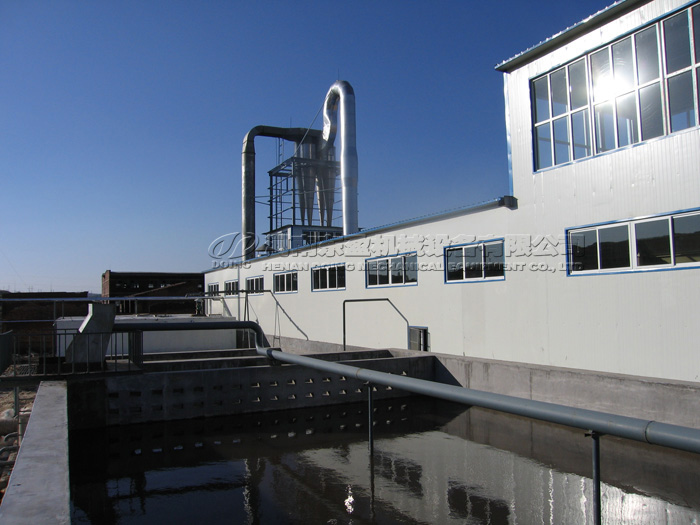 Tapioca starch processing plant upgrade solution
You are upgrading the line you already have, so the question is not “upgrade or build new” — it is which stages to touch, in what order, and how deep.
Two scopes fit most plants:
| Single-bottleneck fix | Staged full retrofit | |
| What it touches | One stage | Each stage, in sequence |
| Downtime | A weekend | Several short windows |
| Payback | Fastest | Longer, but near new-build |
| Best when | One stage clearly caps you | Several stages near their limit |
Do the highest-return, shortest-downtime stage first. Keep what still works — motors, frames, conveyors — and replace only the bottleneck parts. Before you commit, answer two questions: what is your budget, and how many downtime days can you absorb? Those two numbers decide how many stages you move at once.
A supplier such as Jinrui Foodtech (Henan Jinrui) can run an upgrade assessment first and scope the work to your actual bottleneck, so you avoid paying to replace equipment that still has life in it.
Three stages set the plant’s ceiling — rasping, fiber sieving + starch refining, and drying. The remaining stages should keep pace, and only get attention once the big three have been lifted and they become the new constraint.
| Stage | What caps you | Equipment change | Process change |
| Rasping | Yield + throughput start | Rasper capacity (t/h), blade material & sharpness, screen aperture, feed uniformity | Finer particle size; tight rasping-to-extraction window; circulation load |
| Fiber sieving + refining | Purity + separation | More sieve/centrifuge stages, curved screens, desander, refining passes | 2→3 wash stages; water-to-starch ratio; wash-water recovery; purity target |
| Dewatering + drying | The real limit | Dewatering unit + dryer type (flash/cabinet/rotary), cyclone, dust collection | Moisture into dryer; residence time; outlet moisture |
3.1 Rasping & extraction
A well-set rasping stage recovers 5–8% more starch from a baseline of 85–88% recovery, and that alone often pays back an upgrade within a year. Coarse rasping leaves starch in the fiber — no later stage gets it back.
3.2 Fiber sieving, desanding, and starch refining
Upgrading from 2–3 to 4–5 screening stages typically lifts separation capacity by 30–60% and cuts specific water use. Skip this and the line runs faster upstream but ships a lower grade — the upgrade created a bottleneck in quality, not just volume.
3.3 Dewatering and drying
The variable that matters most is moisture into the dryer, which the dewatering stage sets: drier feed means the dryer handles more throughput. Rasping and separation can be lifted all day, but if moisture does not drop, the whole plant still waits on the dryer.
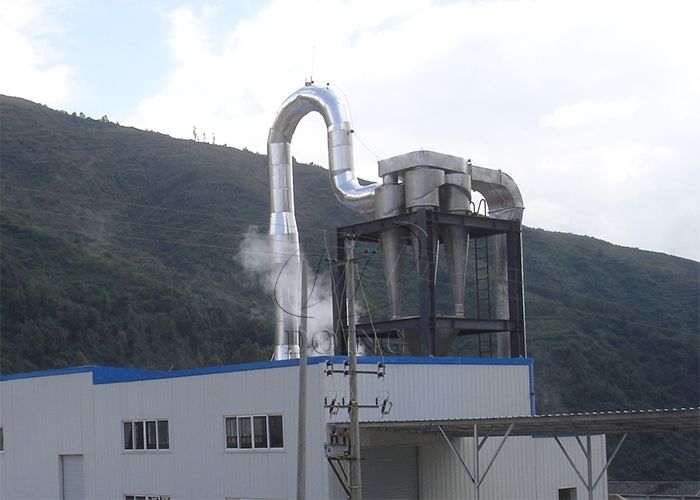 Flash dryer for tapioca starch production
An upgrade only pays if the line comes back fast and runs steady.
Schedule off-season where you can, install new modules in parallel so the old line keeps running, and switch over in stages.
Bring utilities up with the process — water loop, steam, PLC controls, instrumentation. A bigger rasper behind an unchanged water or power supply just moves the bottleneck to the utilities.
Ramp up with checks — calibrate new set points, retrain operators on the changed stages, and compare yield and moisture against samples from before the upgrade.
Jinrui Foodtech provides on-site installation supervision, operator retraining, and spare-parts support, and can plan a phased retrofit that keeps the existing line running.
Q1: How long does the upgrade take, from order to running at the new capacity?
Manufacturing and delivery run 30–75 days, plus 3–6 weeks by ocean freight. Commissioning on an existing line is usually shorter — one to a few weeks. Plan civil or utility tie-ins in parallel so they don’t extend live downtime.
Q2: How do I decide whether to phase the upgrade or shut the line down and do it in one go?
Phase if you must keep shipping — bring new modules beside the running line; do it all at once if you have a seasonal stop, since that’s usually cheaper to install. Rule of thumb: phase when one or two stages move, plan one shutdown when three or more change. Before committing, confirm the old line can run safely beside the new modules and your team can run a half-upgraded line for the weeks it takes.
Q3: What if my production log points to two stages at once, or the bottleneck keeps moving?
When two stages tie, fix the earlier one first. If the bottleneck drifts, check the dryer outlet: moisture or purity drifting there while upstream runs fine means the limit is downstream. Rule out utilities before equipment — a rasper that stalls under load usually signals a power or water shortage. A second, shorter log on just the tied stages settles most ties.
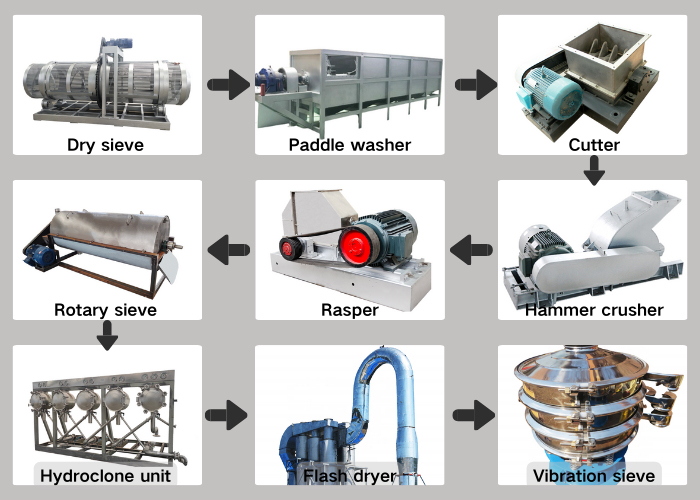 Automatic tapioca starch processing equipment
Q4: What should I verify with the supplier before signing, so the upgrade actually raises output?
Size every stage to the same target, not just the slow one — a faster rasper behind an unchanged dryer leaves you at the old ceiling. Get the dryer–dewatering match in writing and confirm utilities — water, steam, power — are sized for the upgraded line. Those three checks catch most upgrades that look right but ship no extra starch.
Q5: How much of my existing line can I keep, and is there a ceiling to how much one line can be expanded?
Most owners keep the supporting structure and replace only the bottleneck components, protecting the larger share of the original investment. Before reusing a piece, confirm it meets spec for the new capacity; anything undersized or worn drops first. A single line also hits hard limits — its building, utilities, and slowest fixed stage; past those, a second line costs less. Scope each step against those limits so you know when you are near the wall.
Capacity grows when you find the bottleneck, scope the upgrade to it, and bring water, power, and automation up with the process. Send Jinrui Foodtech your current capacity, target capacity, and the stage you suspect is capping you, and get an upgrade assessment and a staged implementation plan built around your existing line.
 Tapioca Starch Plant Upgrade: How Can I Increase Production Capacity?
Cassava Flour Milling in Thailand: Process, Equipment, and Throughput
How Many Tons of Potatoes Make 1 Ton of Starch? How to Start a Profitable Potato Starch Processing Business?
How Much Space for a 5tph Cassava Starch Processing Plant? Complete Factory Layout & Setup Guide
What Is the Market Price of Cassava Flour and Is Cassava Flour Processing Profitable?
From Fresh Cassava to Cassava Flour: A Complete Dry Process
Can cassava flour processing be a profitable alternative to wheat flour?
Is the Fufu Flour Processing Business Profitable?
Why Is the HQCF (High Quality Cassava Flour) Processing Business So Popular in Nigeria?
What Budget Is Required to Start a Cassava Flour Production Business in Congo?
Henan Jinrui Secures 2-in-1 Processing Line Project for Garri and Cassava Flour Production in Gabon
Henan Jinrui delivers attieke processing equipment to the customer in Côte d'Ivoire
Henan Jinrui Successfully Ships Cassava Flour Processing Line to Madagascar Client
Henan Jinrui Advanced Cassava Starch Processing Equipment Wins Over Nigerian Food Processor
Henan Jinrui Delivers Custom 1TPD Garri & Attieke Making Equipment to Benin
Tapioca Starch Plant Upgrade: How Can I Increase Production Capacity?
Cassava Flour Milling in Thailand: Process, Equipment, and Throughput
How Many Tons of Potatoes Make 1 Ton of Starch? How to Start a Profitable Potato Starch Processing Business?
How Much Space for a 5tph Cassava Starch Processing Plant? Complete Factory Layout & Setup Guide
What Is the Market Price of Cassava Flour and Is Cassava Flour Processing Profitable?
From Fresh Cassava to Cassava Flour: A Complete Dry Process
Can cassava flour processing be a profitable alternative to wheat flour?
Is the Fufu Flour Processing Business Profitable?
Why Is the HQCF (High Quality Cassava Flour) Processing Business So Popular in Nigeria?
What Budget Is Required to Start a Cassava Flour Production Business in Congo?
Henan Jinrui Secures 2-in-1 Processing Line Project for Garri and Cassava Flour Production in Gabon
Henan Jinrui delivers attieke processing equipment to the customer in Côte d'Ivoire
Henan Jinrui Successfully Ships Cassava Flour Processing Line to Madagascar Client
Henan Jinrui Advanced Cassava Starch Processing Equipment Wins Over Nigerian Food Processor
Henan Jinrui Delivers Custom 1TPD Garri & Attieke Making Equipment to Benin
DOING company offers cassava processing machine from single machine to the complete production line. If you want to get more details about Tapioca Starch Plant Upgrade: How Can I Increase Production Capacity? , please contact us: