Tel/WhatsApp
0086 135 2661 5783

Henan Jinrui Food Engineering Co., Ltd

Neither individual machines nor a turnkey potato starch processing line is automatically the better choice. Individual machines or modular equipment can be the right solution for an existing plant, a bottleneck upgrade or a phased investment. A turnkey line is usually a better fit for a new project that needs one coordinated process, integrated equipment and clearer responsibility during installation and commissioning.
The practical decision is not simply “Which option is cheaper?” Buyers should compare what each solution actually includes: the process stages, equipment configuration, plant interfaces, engineering work, site services, acceptance conditions and after-sales support. This guide explains what the two solutions look like in practice and how to compare a supplier’s proposal before ordering.
The main difference is not only the number of machines. It is the boundary of the supplier’s responsibility. An individual-machine order normally solves a defined processing section. A turnkey project connects the processing sections into one operating line.
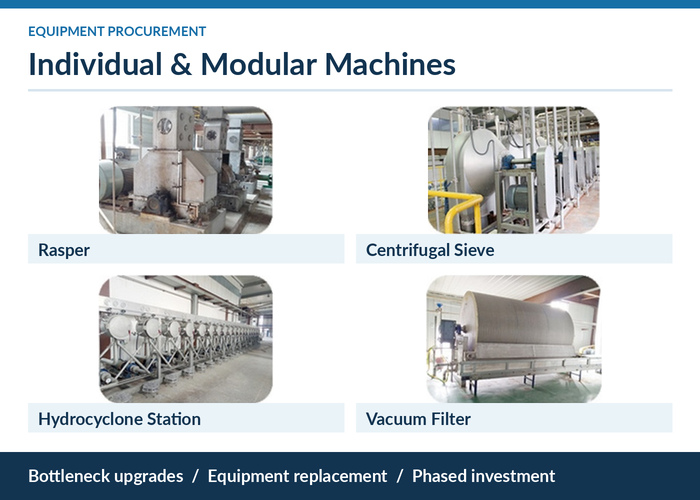 Potato starch processing equipment
An individual-machine solution starts with a specific need. The buyer may require a washing unit for raw-potato cleaning, a rasper for cell disruption, centrifugal sieving for starch extraction, a hydrocyclone system for purification, a dewatering unit, or a flash dryer for producing dry starch. The exact equipment depends on which part of the existing process is missing, underperforming or being expanded.
A modular package can include several connected machines for one section rather than a single standalone machine. For example, a buyer may purchase a separation module with the related pumps, tanks, piping connections and controls, while retaining the existing washing or drying section. This is more useful than treating every machine as an isolated catalogue item because the new module still has to match the upstream flow and downstream capacity.
In this model, the supplier may be responsible for equipment selection, manufacturing, technical documentation, connection requirements, spare parts and machine-level support. The buyer, its engineering contractor or several suppliers may remain responsible for the overall process route, civil works, plant layout, utilities, interconnections and final line commissioning. These boundaries should be written into the quotation instead of being assumed.
The main advantage is flexibility. The buyer can replace a bottleneck, preserve usable equipment and spread investment across stages. The limitation is coordination: a machine with an attractive catalogue capacity may still be unsuitable if its feed condition, discharge flow, controls, water demand or installation space do not match the rest of the plant.
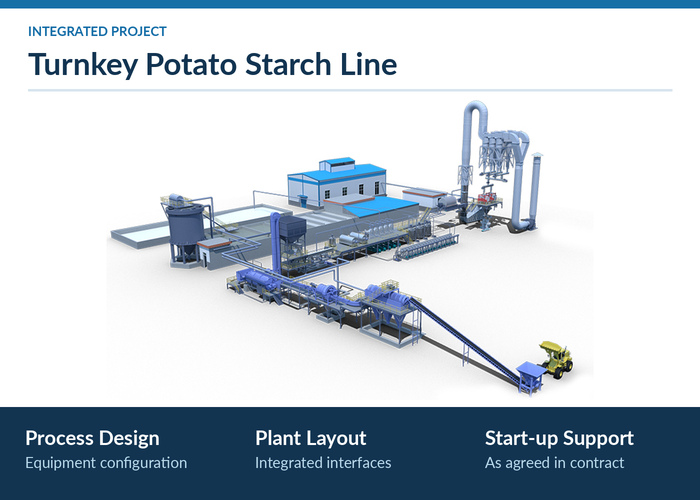 Potato starch processing plant
A turnkey potato starch processing line is designed as one project from raw-potato intake to the required finished product. A typical wet-processing scope may connect raw-potato receiving and cleaning, washing and destoning, rasping, starch extraction and sieving, fiber separation, desanding, hydrocyclone purification, dewatering, flash drying, starch sieving and packaging.
The equipment list is only one part of the solution. A complete line proposal may also include process-flow design, equipment configuration, plant-layout support, material-transfer arrangements, tanks and piping, electrical and PLC controls, installation guidance or site installation, commissioning, operator training and after-sales support. The included scope depends on the supplier and contract, so every service must be identified as included, optional or excluded.
Jinrui Foodtech (Henan Jinrui) can use the buyer’s raw-potato condition, target processing requirement, finished-starch specification and site information to develop either a selected-equipment package or a complete potato starch line proposal. The important point for the buyer is to review the process flow, equipment list and service boundary together, rather than evaluating a turnkey label on its own.
The main advantage of a turnkey solution is centralized integration. One project party can coordinate the relationships between equipment, process flow, layout, controls, installation and commissioning. The limitation is that a broader project scope generally requires more decisions before ordering, including site preparation, utilities, acceptance testing and future expansion provisions.
Buyers should compare the two procurement models against the same project requirements. The following table shows where the work normally sits; it is not a promise that every supplier includes the same services.
| Comparison factor | Individual or modular machines | Turnkey potato starch line |
|---|---|---|
| Equipment scope | Selected machines or one processing section | Coordinated equipment scope from intake to the agreed product endpoint |
| Process integration | Buyer, engineer or several suppliers coordinate interfaces | Main process route and interfaces are coordinated within the project scope |
| Plant layout | Usually prepared by the buyer or a separate engineering party | May be developed or supported by the line supplier |
| Installation and commissioning | Often arranged separately unless specifically quoted | Can be included as project services, subject to contract |
| Initial investment timing | Easier to divide into replacement or upgrade stages | More of the integrated scope is planned and purchased together |
| Buyer-side technical work | Higher responsibility for matching machines and interfaces | Lower coordination burden, but accurate site information is still required |
| Flexibility | Strong for replacement, modification and staged expansion | Strong for integrated start-up; future modularity must be planned |
| Main risk to check | Capacity, control, utility and connection mismatch | Unclear exclusions, acceptance conditions or service boundaries |
This comparison also explains why a lower machine price does not automatically mean a lower project cost. A narrow individual-machine offer may exclude piping, controls, installation and commissioning. A broader turnkey offer may include these items but still exclude civil works, utilities or local site preparation. The proposals become comparable only after the scope is normalized.
An individual-machine or modular solution is the right choice when the buyer has a defined upgrade need rather than a requirement to build the entire potato starch process from zero. The project may involve one machine, a connected processing module or a staged equipment package.
This model fits an operating plant that only lacks one machine, needs to replace worn equipment or has a bottleneck in rasping, starch separation, dewatering or drying. The new equipment should be selected against the actual feed condition, discharge requirement, utilities, controls and space available in the existing line.
For example, a separation upgrade may require changes to pumps, tanks, piping and control logic. A drying upgrade may require a review of upstream dewatering and the available heat or air system. The purchase is therefore an equipment solution for a specific process section, not a machine chosen by catalogue capacity alone.
Individual machines are more suitable when the buyer or its appointed contractor can manage process connections, plant layout, material transfer, utilities, electrical integration and final commissioning. This capability allows the buyer to coordinate equipment from different suppliers and take responsibility for making the complete line operate as one system.
If that capability is limited, the buyer should ask the equipment supplier to define the additional support available. The quotation should distinguish machine supply from equipment sizing, technical drawings, interface dimensions, installation guidance, commissioning assistance and operator training.
A modular purchase can be useful when the buyer wants to invest in stages, validate a processing section before expanding, or match equipment investment to developing raw-material supply and market demand. The first phase should still be planned around the future line.
Confirm the space, connection points, control-system compatibility, utility capacity and material-transfer route reserved for later equipment. This prevents a small first phase from creating expensive rework when the buyer expands to a complete potato starch line.
Jinrui Foodtech can support this type of project with selected potato starch machines, connected processing modules, equipment matching, interface recommendations, spare-parts guidance and technical support for an upgrade. The practical deliverables should be agreed from the beginning: machine scope, technical data, connection requirements, installation boundary, commissioning support and future expansion assumptions.
This approach gives an existing plant a way to improve a defined section while keeping usable equipment in service. It also makes the buyer’s responsibility clear: unless the quotation states otherwise, the buyer or its engineering contractor remains responsible for the wider line integration and site work.
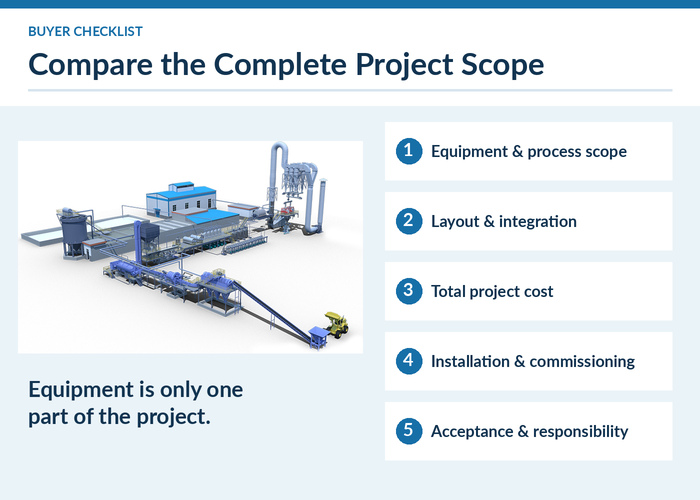 Compare potato starch equipment quotes
A turnkey potato starch line is the better solution when the buyer is developing a new plant or needs one coordinated party to connect raw-material handling, starch extraction, purification, drying and packaging into a complete project.
A new plant needs more than a list of machines. It needs a connected route from raw-potato receiving, washing and destoning through rasping, starch extraction, fiber separation, purification, dewatering, drying, starch sieving and packaging. The project also needs tanks, pumps, piping, electrical controls, maintenance access and utility interfaces.
A turnkey configuration is useful because these elements can be planned together. It reduces the risk of buying machines that are individually suitable but incompatible in feed flow, control logic, installation space or downstream capacity.
A complete line should be configured around the buyer’s potato condition, target processing requirement, finished-starch specification, workshop dimensions and available utilities. FAO guidance on post-harvest vegetable handling (https://www.fao.org/3/a-au162e.pdf) emphasizes that harvesting, transport, physical damage and the time before processing can affect raw-material quality. That is why the project brief should describe the potatoes arriving at the plant, not only the desired machine list.
For a turnkey project, the supplier should connect the equipment list to a process flow and plant layout. The buyer should be able to review where materials enter and move, where pumps and tanks are placed, how utilities reach each section and how operators access the equipment for cleaning and maintenance.
A turnkey solution is particularly useful when the buyer does not have a mature potato starch process-design team or does not want to coordinate multiple equipment suppliers. Depending on the agreed scope, one supplier may coordinate equipment configuration, process interfaces, layout support, installation, commissioning, trial running, operator training and after-sales service.
“Turnkey” does not automatically mean that every service is included. The quotation should state whether the supplier provides remote guidance, installation supervision or full site installation, and what the buyer must prepare, including civil works, water, power, heating or drying systems, drainage, labor and trial raw materials.
Jinrui Foodtech provides potato starch equipment and can configure a complete line around the buyer’s raw-material conditions, processing requirement, product specification and site information. The project proposal can be reviewed through an equipment list, process flow, plant-layout recommendation and clearly defined service boundary.
Installation guidance, commissioning, operator training and after-sales support should be confirmed in the project quotation and contract. This keeps the proposal accurate while giving the buyer a clear path from equipment selection to line start-up. It also makes it possible to compare the complete-line proposal with an individual-machine package on the same scope basis.
The most useful quotation is one that lets the buyer compare scope, responsibility and operating assumptions—not just the number of machines or the headline price.
Ask the supplier to map each quoted item to its process position. A complete potato starch equipment proposal may need to address:
raw-potato receiving, conveying, cleaning and destoning;
rasping and starch extraction;
centrifugal sieving and fiber separation;
desanding and hydrocyclone purification;
dewatering and flash drying;
starch sieving and packaging;
pumps, tanks, piping, conveyors and electrical controls;
installation materials, initial spare parts and wearing parts, where applicable.
The list should distinguish the main processing equipment from auxiliary equipment and local works. It should also show the design basis, such as raw-material condition, target capacity definition, product requirements and operating assumptions. Do not compare one supplier’s main-machine list with another supplier’s full project scope.
A machine price may exclude layout design, interconnecting piping, controls, installation, commissioning, training, packaging, civil works, utilities, wastewater handling, shipping, local labor or spare parts. A turnkey price may include some of these items but exclude others.
When reviewing a supplier proposal, buyers should request an included-scope list, excluded-scope list and optional-items list alongside the process flow and equipment layout. This makes an individual-machine package, a modular upgrade and a turnkey line easier to compare on the same commercial basis.
The quotation or contract should clarify who is responsible for process configuration, equipment supply, layout, installation, commissioning, operator training, acceptance testing and warranty support. It should also define the warranty start point, spare-parts scope, technical-response method and site conditions supplied by the buyer.
Performance language should have a measurable basis. Depending on the project, this may include the raw-potato condition, input or output definition, product moisture, finished-starch quality, operating conditions, test duration and acceptance method. Clear assumptions protect both the buyer and the supplier better than a general statement such as “high capacity” or “stable performance.”
Yes, but ask for an expansion review before ordering the first stage. The review should cover reserved floor space, future connection points, control-system architecture, utility capacity, material-transfer routes and the condition of any existing equipment that will remain in service.
Sometimes. The existing equipment should be checked for condition, useful capacity, materials, control compatibility, connection dimensions and sanitation or maintenance requirements. The supplier should identify any adaptation work and the effect of retained equipment on the line’s acceptance conditions.
Provide the potato type and condition, seasonal raw-material availability, target input or starch output, finished-product requirements, workshop dimensions, available water and power, heating or drying conditions, project location, automation expectations and the equipment you already own. This allows the supplier to prepare a project-specific scope rather than a generic catalogue offer.
Ask the supplier to explain the process flow, equipment interfaces, utility assumptions, control boundary, layout logic and commissioning sequence in plain language. A capable supplier should be able to show what happens between the major machines and identify which responsibilities remain with the buyer.
Choose individual or modular potato starch machines when you are upgrading an existing plant, replacing a defined bottleneck, retaining usable equipment or investing in stages with your own engineering support. Choose a turnkey potato starch processing line when you are building a new plant or need one coordinated party to connect process design, equipment, layout, commissioning and training.
The best solution depends on the actual project boundary. Jinrui Foodtech can review whether your requirement is better served by a selected machine, a modular processing section or a complete line proposal. To start the discussion, provide your potato condition, target processing capacity, expected starch output, finished-product requirements, existing equipment, workshop dimensions, utility availability and project location.
 Potato Starch Equipment Buying Guide: Machines or Turnkey?
Low Yield in Potato Starch Processing: Causes and Solutions
Tapioca Starch Plant Upgrade: How Can I Increase Production Capacity?
Cassava Flour Milling in Thailand: Process, Equipment, and Throughput
How Many Tons of Potatoes Make 1 Ton of Starch? How to Start a Profitable Potato Starch Processing Business?
How Much Space for a 5tph Cassava Starch Processing Plant? Complete Factory Layout & Setup Guide
What Is the Market Price of Cassava Flour and Is Cassava Flour Processing Profitable?
From Fresh Cassava to Cassava Flour: A Complete Dry Process
Can cassava flour processing be a profitable alternative to wheat flour?
Is the Fufu Flour Processing Business Profitable?
Myanmar Customer Orders Cassava Starch Machines After Two Jinrui Factory Visits
Jinrui Foodtech at the 19th Nigeria (Lagos) China Commodities Expo 2026 — Booth 1B09
Jinrui Foodtech Signs Rasper Order With Philippine Cassava Starch Producer for a Phased Line Upgrade
Jinrui Foodtech Secures 2-in-1 Processing Line Project for Garri and Cassava Flour Production in Gabon
Jinrui Foodtech delivers attieke processing equipment to the customer in Côte d'Ivoire
Jinrui Foodtech offers cassava processing machine from single machine to the complete production line. If you want to get more details about Potato Starch Equipment Buying Guide: Machines or Turnkey? , please contact us: